
With the ever-increasing cost of living, getting by while living in Toronto is difficult for many residents. We’ve seen that housing is unaffordable through our the federally funded research we conducted in South Etobicoke, Toronto and more recently, tenants city-wide have organized protests in response to continued rent increases. One case, in South Etobicoke, proposed rental and condominium on Lake Promenade, tenants are gearing up for a great fight against a mass eviction. Housing affordability remains a complex issue that major cities are grappling with when competing interests and limited data are informing policy decisions.
Painting a Clearer Picture
To better understand the characteristics of those facing unaffordable rents, we examined data about household sizes and types, demographic characteristics, and housing needs. This is important to determine if changing population demographics match housing development types. This could also be considered as criteria for developers to meet to ensure that housing suitability and adequacy meet the city’s needs as a top priority.
The Research
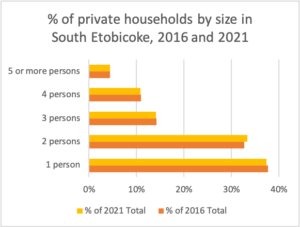
According to the most recent census[1], over 35% of households in South Etobicoke are 1-person households, and the next largest group is 2-person households at just over 30%, graph below.
1-person and 2-person households are more likely to be renting their dwelling. This is especially true for lone-parent households (who make up 13% of renters) and seniors living alone (10% of renters). Meanwhile, households with three or more people are a smaller percentage of all households but are more likely to own their dwelling, graph below.
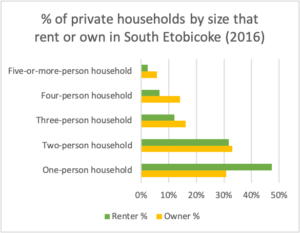
Households with children are more likely to be owners, but a sizable proportion, around 13%, are renters.
Of the renter households that were in core housing need[2], 77% were below the affordability standard, and about 50% were below the suitability and adequacy standards[3]. Again, renters with certain characteristics were most likely to be facing core housing need: especially lone-parent households (52%) and seniors living alone (over 64%).
We know from our earlier work that people receiving support from ODSP, households living on minimum wage, and even single people working full time with the median income for South Etobicoke all cannot afford the median rent for a bachelor unit in South Etobicoke – they would have to pay more than 30% of their income on rent. We previously estimated that nearly half of Etobicoke-Lakeshore’s adult population (nearly 50,000 individuals) are not making enough to afford to rent a bachelor unit in their ward. This is much higher than previously reported in 2021: 32% of the population in Toronto was in unaffordable housing, 40% were spending over 30% of their income on rent and utilities, and 18% were spending over 50% of their income.
Suitability
When we look at the housing market in Etobicoke-Lakeshore, according to the 2021 census, we see that in addition to a lack of affordable housing, there is a mismatch in household sizes and dwelling sizes. This may contribute to core housing need, particularly around the suitability of housing: 19% of renter households in Toronto are living in overcrowded conditions, and racialized renters are more likely to live in these conditions. 1 person households made up 37% of the households in the area, but only 33% of the dwellings had no bedrooms or one bedroom. Households with 4 or more people made up 15% of the households, but only 12% of dwellings had 4 or more bedrooms. Meanwhile, there’s a higher proportion of units with 2 bedrooms (35%) than there are households with two people (33%), and a higher proportion of units with 3 bedrooms (21%) than there are households with three people (14%).
The census also revealed changes in the prevalence of certain household types. 35% of adults aged 20 to 34 are living with at least one parent, and living with roommates or with extended family members has grown in popularity. Canada has one of the lowest proportions of one-person households in the G7, and roommates are the fastest-growing type of household; between 2001 and 2021, this household type increased by 54%. This suggests that many are finding ways to access affordable housing by sharing shelter costs with others or by living with family members further into their adult life.
Population trends suggest that some are managing housing costs by moving elsewhere, especially for residents in Toronto. The city is seeing a new trend in its population: in 2022, Toronto saw a record inflow of immigration, seeing an increase of 103% in 2022 compared to the previous year. Meanwhile, tens of thousands of residents left Toronto, suggesting that the city is no longer a place where Canadians seek opportunity. Without adequate investment in affordable housing, those who are most vulnerable and who may not have the resources to move away will continue to be left without housing that meets their needs and enables them to thrive in the city.
Written by: Research Assistant Natalie Pilla | LinkedIn
References
[1] Statistics Canada data sources used in this blog are the following: Census Profile 2021, Etobicoke–Lakeshore and Census Profile 2016, Etobicoke–Lakeshore
[2] A household is in core housing need if its housing does not meet one or more of the adequacy, suitability or affordability standards and would have to spend 30% or more of its before-tax income to access acceptable local housing. You can read the full definition here from CMHC: www03.cmhc-schl.gc.ca/hmip-pimh/en/TableMapChart/CoreHousingNeedMethodology
[3] Data source: www03.cmhc-schl.gc.ca/hmip-pimh/en#Profile/227005/5/Etobicoke (South)