
January 16, 2023
Among the wide variety of programs and initiatives supported by municipal funding, part of the City of Toronto’s budget goes towards affordable housing initiatives, the shelter system, and housing supports in the city. However, despite continued issues around affordability and homelessness, funding to address these issues continues to lag behind residents’ needs. According to The Wellesley Institute’s review of data from the 2021 Census, compared to 2011, more people in Toronto are renting their homes than ever before. In 2021, of the 30% of Toronto’s private households that earn less than $60,000 annually, three quarters of those who rent spent more than 30% of their income on shelter costs. This accounts for around 300,000 households.
Currently, there is very little data available on the number of affordable housing units, and the number of those approved and under construction. According to data from the City of Toronto Housing Secretariat, Toronto completed 366 affordable rental housing units in 2019, 212 rental affordable housing units in 2020, and projected to complete 1,070 units in 2021. These units make up less than 1% of all units completed between 2019-2021 in Toronto and come nowhere close to aligning with the number of those in need of affordable housing.
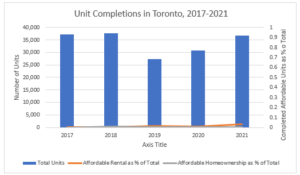
As we’ve seen in South Etobicoke, fewer and fewer homes are available at rents affordable to low-income households. The people most impacted by unaffordable rents are those earning minimum wage or less, older adults on fixed incomes, ODSP and OW clients, and students. Existing apartments have become more expensive over time, as average rents in the GTA have outpaced increases to income, and most units built in recent years were high-cost rental condos. Councilors, decision-makers and policymakers need to prioritize the creation and preservation of affordable rental housing targeting low- and moderate-income households and ensure that adequate funding is available to support these initiatives.
Funding and Budget for Affordable Housing in Toronto
Community and Social Services and Agencies took up most of the 2022 City of Toronto Budget.
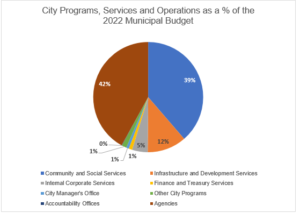
Agencies accounted for 42% of the budget[1] while Community and Social Services took up 39% of the budget[2].
[1] The programs and services that fall under the “Agencies” category include Toronto Public Health; Toronto Public Library; Association of Community Centres; Exhibition Place; Heritage Toronto; TO Live; Toronto Zoo; Arena Boards of Management; Yonge-Dundas Square; CreateTO; Toronto & Region Conservation Authority; Toronto Transit Commission (Conventional & Wheel Trans); Toronto Police Service; Toronto Police Services Board; and Toronto Community Housing Corporation Subsidy.
[2] The programs and services that full under the “Community and Social Services” category include Housing Secretariat; Children’s Services; Court Services; Economic Development & Culture; Toronto Paramedic Services; Seniors Services and Long-Term Care; Parks, Forestry & Recreation; Shelter, Support & Housing Administration; Social Development, Finance & Administration; Toronto Employment & Social Services.
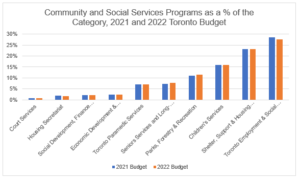
The programs and services in this category that support housing in the city are the Housing Secretariat and Shelter, Support & Housing Administration. The secretariat is responsible for the delivery of new affordable homes, preserving Toronto’s existing housing stock, and helping residents access and maintain safe, secure, adequate, affordable housing. It makes up 0.7% of the City’s 2022 budget, accounting for $7.2 million. The housing administration is responsible for managing the system of homeless and housing services. It makes up 9% of the City’s 2022 budget, accounting for $977 million.
The Toronto Community Housing Corporation Subsidy plays an important role in providing affordable and supportive housing in the City of Toronto and ensuring that tenants of this housing have quality homes, consistent service, and feel safe in their communities. This program takes up 2.5% of the City’s 2022 budget, accounting for $275 million. Combined, these three programs that support affordable and supportive housing initiatives and homelessness services make up less than 15% of the total city budget for 2022.
The programs and services that take up the largest proportion of the budget are Toronto Employment & Social Services (10.6%), the Toronto Police Service (11.6%), and the Toronto Transit Commission (19.3%). During the 2022 budget proposal and approval process, a $25 million increase to the Toronto Police budget was proposed. Previous attempts to reallocate funds from the police budget to housing initiatives failed, despite strong calls at public deputations to do so. Additionally, a councilor’s motion to reduce the $25 million increase to the police budget by $2.6 million to be used for the RentSafeTO and Multi-Tenant Homes programs also failed. Despite the need for ongoing and increased housing supports and affordable housing development, the police budget continues to be a funding priority for City Council.
In 2023, the housing crisis continues, in many ways worsened by the impacts of the pandemic. The 2023 City Budget is in development, under new mayoral powers. Though the size of the police budget was one of the concerns of Toronto voters in 2022, the mayor is continuing to push to decrease and re-allocate funding for the Toronto Police Service. CBC has reported that the Toronto mayor wants to boost the Toronto Police Service budget by 4.3%, or $50 million, to a total budget of more than $1.1 billion. This funding is intended to be used to hire more Police Service officers in response to increased violence across the city and on its transit system.
Advocates and some city councilors have argued that this increase in police funding will do the opposite of what its intended to do. Additionally, other methods of addressing crime and violence are more effective. Re-directing funds to initiatives that address food insecurity, mental health, and housing, among other initiatives that aim to proactively reduce crime, are options. Investing in communities reduces crime and improves resiliency – investing in policing increases surveillance and violence against community members living in poverty.
One of the SEHA study’s recommendations to improve the state of housing affordability is to reinvest in supportive and community housing, and subsidies and repairs, to ensure that those living with low incomes have affordable housing options. This type of investment ensures that everyone has a safe and adequate place to call home that meets their needs. Without it, and with an increased focus on policing, the most vulnerable community members will have less access to needed supports and will face more surveillance and violence in their daily lives.
Community voice, especially in the face of strong mayor powers, needs to be strong and clear. In the coming weeks, there is still an opportunity to influence the Toronto budget and push for more funding for affordable housing and for investments in social services that support our communities.
To make it clear to mayor John Tory and the City Council that now is the time for real investments that make our city more affordable, accessible, and safer for everyone, you can:
- Contact Amber Morley, Councilor for Etobicoke-Lakeshore and share your views on what needs to be prioritized in the city budget at councillor_morley@toronto.ca.
- Attend Amber Morley’s Budget Town Hall
- Monday, January 16th, 2023, at 6:30pm – 8:00pm
- Council Chambers, Etobicoke Civic Centre, 399 The West Mall, Etobicoke, Ontario
- RSVP on the website
- Make a deputation
- As part of the budget process, the Budget Committee receives public input through public deputations. This is an opportunity for community members to voice their concerns, advocate for the community’s needs, and shape budget decisions. Anyone can depute!
- If you are interested in deputing, register to speak by emailing buc@toronto.ca or call 416-392-4666 by 4:30 pm on Monday, January 16, 2023.
- If you want to share written comments and feedback to the Budget Committee, email buc@toronto.ca.
- Deputations will take place on January 17th and 18th.
- You can learn more about how to present an effective public deputation here or attend a training event on how to make an effective oral or written deputation.
Research Assistant Natalie Pilla